Pages

Saturday, April 5, 2014

Coming to a School Near You.....

This blog is a clearinghouse for the best in education news, interspersed by personal comments from me. This piece details the frightening scenario of public assets being capitalized by the monied elite. Even though it seems like a distant urban problem at the moment, we all need to educate ourselves and be aware that we're next in line. 

http://educarenow.wordpress.com/2013/06/19/accumulation-by-dispossesion/
Educare- Latin, "To draw out that which lies within." Now- the only time we have. Thoughts on education by Bill Boyle. Thoughts expressed here are my own.

Accumulation by Dispossession


Kirsten L. Buras has written a scathing indictment of the neoliberal reform agenda in Race, Charter Schools, and Conscious Capitalism: On Spatial Politics of Whiteness as Property (and the Unconscionable Assault on Black New Orleans).. Though it was written 2 years ago (2011), and though it focuses on New Orleans in its Post Katrina reform, this paper outlines what is now going on across the country. It’s an important contribution to naming and recognizing a pattern constituted of pieces that, when considered separately, are seemingly harmless pieces of policy. However, when considered as a whole, as Buras does so well, it becomes clear that these policies work towards the deconstruction of the ‘common’ in public education and replace it with a privatized conception of the market that benefits the elite. Buras’s paper is also important in that in excavates the importance of race in the creation of policy, and the ways in which race is used to leverage policy in favor of the privileged in spite of the language the privileged generate.
Buras argues that, regardless of the stated intent of restructuring education for the benefit of the underprivileged through the establishment of charter schools that ostensibly shake up the ‘status quo,’ “New Orleans charter schools are less about responding to the needs of racially oppressed communities and more about the Reconstruction of a newly governed South- one in which white entrepreneurs (and black allies) capitalize on black schools and neighborhoods by obtaining public monies to build and manage charter schools.”
Unfortunately, this is no longer news. The same intention, and virtually identical polices supporting it, is spreading around the country. Since this article was written, as two quick examples, Chicago has closed 28 schools and Michigan has started its Educational Achievement Authority- a state-wide school district designed to take over Michigan’s lowest 5% performing schools, (and oddly supplemented with $60 million in private funding). There are many more virtually identical examples of the neoliberal pattern from New York to Wisconsin.
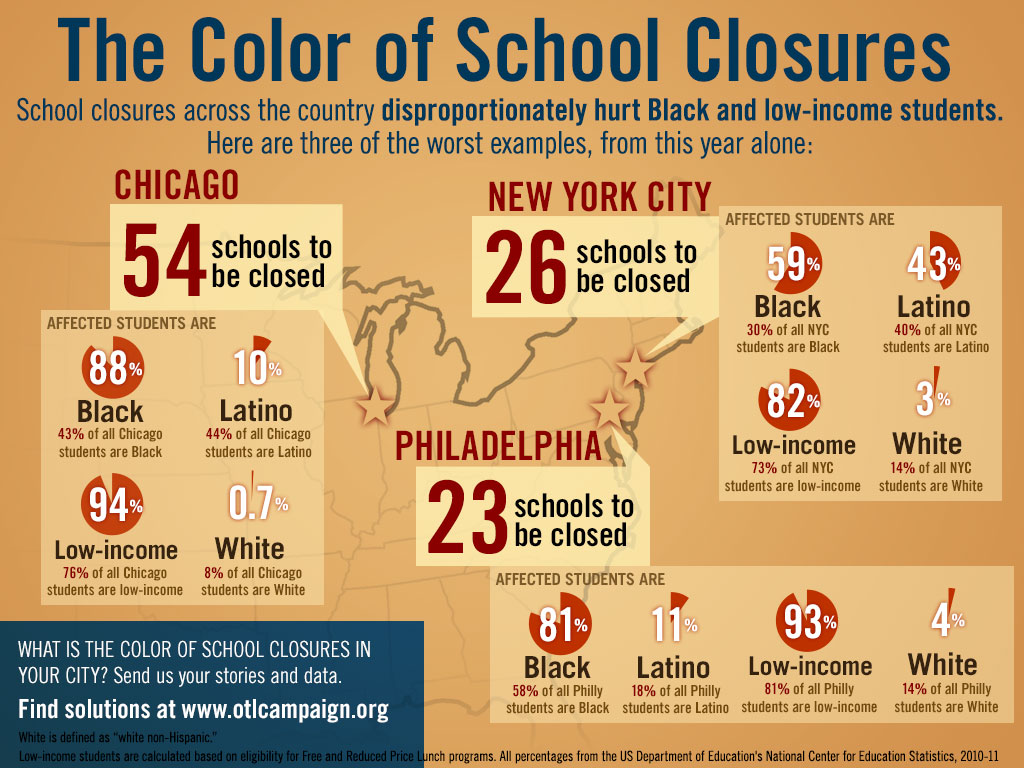
What do these situations have in common? They all take place in areas of high poverty and large minority populations, areas ripe with so-called ‘failing’ schools located in clearly stressed communities. And the educational crisis in these demographic areas always translates into a profit making opportunity, what Buras calls, ‘white accumulation.’
This graph (click on image to enlarge) visually makes this point very clear:
The Color of School Closings
(For a clearer look at the graph with more information, go here.)
Buras asks, “…in what ways does whiteness function as a form of property, endowing its possessors with the rights to use, appropriate, and benefit from the city’s assets while dispossessing or excluding communities of color from the same entitlement?”
Buras goes on to outline the key characteristics of the reform that leads to dispossession, the privatization of what has traditionally been held in common:
1. The argument that a market driven, competitive model of education works best. Note what Henry Giroux calls ‘market fundamentalism.’
2. The assertion that doing away with local politics and bureaucracy (with denigrating references to the ‘obstacle’ of unions) will lead to fresh and innovative practices. Essentially, this demonizes democratic practices as being obstacles to efficiency. Also, it is not coincidental, for instance, that Michigan’s EAA is a state-wide district. It thus has no accountability to a local community.
3. Knowledgeable consumers will equitably navigate the new systems based on access to data. Note the shift from citizenship to ‘consumers.’ This also assumes that such consumers have time and energy within the stress of high poverty, to access data. And also note the assumption that this data is accurate and meaningful.
Again, the value of Buras’s article is that it reveals the framework that is being, and has been, used across the country as a means of privatizing the public for the benefit of the privileged at the expense of the poor and much less powerful. Buras puts it this way:
“Educational reforms in New Orleans are not designed to respond to oppressed communities or to enhance public school performance, even if they ar often couched in such language. Rather, this is a feeding frenzy, a revivified Reconstruction-era blueprint for how to capitalize on public education and line the pockets of entrepreneurs (and their black allies) who care less about working-class schoolchildren and their grandmothers and much more about obtaining public and private monies and an array of lucrative contracts...These reforms are a form of accumulation by dispossession, which David Harvey defines as process in which assets previously belonging to one group are put in circulation as capital for another group. In New Orleans, this has included the appropriation and commodification of black children, black schools and black communities for white exploitation and profit.”
And, as I have said, this is no longer only about New Orleans. Nor, as I have argued elsewhere , will this agenda continue to focus only on areas of high poverty/high minority concentrations. More policies that increase ‘rigor,’ increase high stakes testing and ‘raise standards’ will create more ‘failing schools,’ thus making more communities ripe for privatization. (A logical outcome of the Common Core by the way.) This is merely a symptom of market fundamentalism and the neoliberal project of leveraging the commons for profit. Ultimately this agenda is about dispossessing all of us of what is held in common so that the privileged can benefit from its privatization.
And, regardless of your race or level of income, it’s coming to a school near you.

Friday, April 4, 2014

A Declaration of Professional Conscience..............

A Declaration of Professional Conscience for Teachers: Now, more than Ever


A twenty-year old document provides the teaching profession with something it needs these days more than ever - firm ground upon which to stand as professionals. Teachers were drawn to our work to help our students, and we have the capacity to be strong advocates for them. Perhaps because of this, we are facing unprecedented challenges to our status as professionals. The well-established fact that we are important to the success of our schools has been transformed into a terrible indictment - since we are so important, we must be responsible for all the system's shortcomings. And since we have not managed by ourselves to eliminate age-old gaps in achievement, and send all our students to college, we must have our output measured as if we are on an assembly line, and our instruction scripted and structured according to supposedly proven curricula.
Sometimes this criticism reduces us to a posture where we simply are defending ourselves. And we lose sight of the fact that we are indeed here for the children. If our classrooms are to be places that nurture them, our schools must nurture and support us as teachers. If our children are to find their voices and their futures in our classrooms, we must also have our voices heard in our schools and beyond. If we want our students to be nimble thinkers capable of tackling the immense problems they will face, we must create classrooms where such thinking is in use by everyone, most of all their teachers.

We must reclaim what it means to be a teacher.

Twenty years ago, education scholar Ken Goodman wrote a Declaration of Professional Conscience for teachers. It is worth revisiting today.
Dr. Goodman wrote:

A Declaration of Professional Conscience for Teachers

There is a time in the historic development of every human institution when it reaches a critical crossroad. Institutions, like people, cannot stand still; they must always change but the changes aren't always for the better. Human institutions are composed of people. Sometimes the people within the institutions feel powerless to influence the directions of institutional change. They feel they are swept along by a force beyond anyone. Yet people within institutions can determine the directions of change if they examine their convictions and take a principled stand.
That's what the founders of American democracy understood when they began the Declaration of Independence with "When, in the course of human events,..."

Education in the United States is at such a crossroad. At the same time that schools have rededicated themselves to equal educational opportunity for all, laws and policies are being imposed on schools that limit the ability of diligent teachers to use their professional judgment to further the personal development and welfare of their students.


There are strong pressures today to dehumanize, to depersonalize, to industrialize our schools. In the name of cost effectiveness, of efficiency, of system, of accountability, of minimal competency, of a return to the basics, schools are being turned into sterile, hostile institutions at war with the young people they are intended to serve.

As teachers we hereby declare ourselves to be in opposition to the industrialization of our schools. We pledge ourselves to become advocates on behalf of our students. We make the following declaration of professional conscience:

We will make the welfare of our students our most basic criterion for professional judgment.
We have no greater accountability than that we owe our pupils. We will work with parents and policymakers to formulate programs that are in the best interests of our pupils. We will work with the kids to personalize these programs. We will respect all learners. We will cherish their strengths, accept and strive to understand their language and culture, seek to further their personal values, tastes, and objectives. We will oppose methods, materials, and policies that have the intent or effect of rejecting the personal and social characteristics of our students. We will, in all matters, and in all interactions, deal with our pupils fairly, consistently, honestly, and compassionately.
We will do all we can to make school a warm, friendly, supportive place in which all pupils are welcome. Our classrooms will be theirs. We will provide guidance and leadership to support our students in the development of problem-solving, decision-making, and self-discipline. We will help them build a sense of respect and support for each other. We will help them appreciate and respect those who differ from them in culture, language, race, color, heritage, religion, sex, weight, height, physical strength or attractiveness, intelligence, interests, values, personal goals, or any other characteristics.

We will not use corporal punishment on pupils of any age for any offense.
We believe violence begets violence. We will not use marks or schoolwork as punishment. We will seek causes for problems and work with pupils to eliminate the causes of antisocial behavior rather than simply control the symptoms.
Neither will we use tangible, extrinsic rewards such as candy, prizes, money, tokens, or special privileges as a means of controlling behavior. We regard all institutionalized forms of behavior modification as immoral and unethical. We will work with pupils, building on intrinsic motivation in all areas of curriculum and development.
We will accept the responsibility of evaluating our pupils' growth. We will make no long- or short-range decisions that affect the future education of our pupils on the basis of a single examination no matter what the legal status of the examination. We will evaluate through ongoing monitoring of our pupils during our interactions with them. We will strive to know each pupil personally, using all available professional tools to increase our understanding of each and every one.
We are teachers. We are not actors following scripts. We are not technicians servicing an educational machine. We are not delivery systems. We are not police officers, babysitters, petty despots, card punchers, paper shufflers, book monitors. We are not replaceable by machines.
We are professionals. We have prepared ourselves for teaching by building knowledge of human development, human learning, pedagogy, curriculum, language, and cognition. We know the history of education. We know the competing philosophies of education. We have carefully built personal philosophies that provide us with criteria for making teaching decisions in the best interests of our pupils. We have a broad liberal education and an in-depth knowledge of the content areas in which we teach.
We will use our knowledge base to support our students in their own quest for knowledge. The real curriculum is what happens to each learner. We, as teachers, are the curriculum planners and facilitators. We will not yield that professional responsibility to the publishers of texts or management systems. We will select and use the best educational resources we can find, but we will not permit ourselves or our pupils to be controlled by them.

We will continually update our knowledge of education, of our fields of instruction, of the real world, because of our professional dedication to use all means to improve our effectiveness as teachers.
We expect school authorities to support us in our professionalism and self-improvement. And we will oppose all policies that restrict our professional authority to use new knowledge or new pedagogical practices on behalf of our students.
We believe that schools can well serve pupils, parents, and communities if the teachers in them function as responsible, dedicated, and compassionate professionals.

To that purpose we make this declaration of professional conscience.

This statement is available as a downloadable document here. I share it with the author's permission.

Open the pod bay doors, HAL......

Well, we knew this was coming, but now that I actually see it in print I feel like I should watch 2001:A Space Odyssey again and reread 1984 so I know what to expect next. To have so much hinge on a computer's ability to assess good writing  is not just Orwellian, it is absurd and really pisses me off. And to have the first justification for this travesty be that it holds down costs reveals the mentality behind this entire scheme. "I'd like to have someone who actually cares and understands the subtleties of good writing grade your test, Johnny, but it's so much cheaper to let a machine do it." But not to worry, it's a very smart machine... let's name him HAL. And Mr./Ms. teacher, let's allow HAL to decide whether you're doing a good enough job or whether you should be fired. And then let's just have HAL teach the students, since he knows what he will be looking for. Not with a bang, but with a whimper........

http://hechingerreport.org/content/new-common-core-exams-will-test-whether-robo-grader-accurate-human_15312/

The-Woman-Who-Must-Not-Be-Named spouts excrement.

Here is a fantastic riff on The-Woman-Who-Must-Not-Be-Named and how full of BS she really is. It's important to read these to get a better understanding of the people who are robbing teachers of the joy of teaching and students of the joy of learning and turning it all to a tension fraught steaming pile of dung.

http://t.co/2EDLeR2ziX

It's a Movement!

There's an exciting popular movement going on and it's getting bigger every day..... parents, students, and teachers rising up against having the plans of the big money privatizers shoved down their throats through ridiculous standardized tests, bogus teacher evaluation systems, and seeing public education as nothing more than an "emerging market." We're more than data points and investment opportunities, and we're tired of having the jobs and education experience we love turned to shit.

http://dianeravitch.net/2014/04/04/nyc-parent-cancel-the-tests/

Thursday, April 3, 2014

Couldn't have said this better Myself.


An Open Letter To Members Of The House Education Committee

By On March 31, 2014 · Leave a Comment


The following is an open letter, from an Ohio teacher, to members of Ohio’s House Education Committee regarding the hijacking of SB 229.
——————-
Dear Representative,
It was with great concern that I learned of the Ohio House’s decision to make significant, drastic, and educationally unsound changes to SB 229. As an educator I have grave concerns regarding the policies regarding public education that are developed in Columbus.
The evaluative protocol being imposed on local schools from outside the district is an illustration of both the lack of familiarity with a student’s development through their relationship with their teachers as well as further encroachment by the government on local school districts’ rights to self-regulate.
There are a variety of factors that are components to a student’s education, and, though no one argues the necessity of a highly qualified teacher, aspects beyond the control of the classroom teacher have significant influence on a student’s success. For about 50 minutes per day I have the opportunity to spend time with a student. In a large class I may not be able to have the deep and meaningful connections necessary to help guide a student through the complexity of the subject I teach. Hopefully, over the course of time, I can connect with as many students as I can and nurture within them that spark of the love of learning for knowledge’s sake.
I teach art. Our focus on education within this state and nationally is on “core classes” like English, Mathematics, Science, and Social Studies. The arts encompass and utilize these other fields of study, as do all the Humanities. So, though my program is called an ”elective” (and sometimes pejoratively as a “special” or “exploratory”; I prefer the more accurate descriptor “applied academic”) these classes perceived to be the foundation of our education system are at the very core of what I do each day.
We have made innumerable sacrifices to the whole of a student’s education on the altar of higher test scores. Teachers have become unwilling accomplices in the crime against teaching holistically as we are forced to essentially “teach to the test” because such a profound (and artificial) significance is placed on these test scores.  We have reduced children to a series of statistics and we gauge their value on how well they score on a multiple choice test (flawed by it’s very structure as it allows for guessing a correct answer rather than knowing it) given on a particular day or over the course of a particular week (or weeks depending on how many tests the state determines are needed to acquire data).
This dehumanization of the child is abhorrent and does nothing to improve education.  With the current and ongoing legislation being developed in Columbus and implemented across the state this educational Frankenstein monster now swallows up the teachers themselves. Now teachers are evaluated using the same type of flawed logic we have imposed on our students. The evaluative criteria are arbitrary. It is constructed with no substantive input from specialist in the field, i.e. the teachers themselves. It does not take into consideration the vast dynamic forces of the child’s everyday lived experience that influence their school performance. These factors could include something as simple as the fact that some students do not do well on standardized tests because they are kinesthetic or visual learners. Maybe the student was very tired on the test day (or many school days) because they work long hours after school to help support their family financially. Maybe they have a home life that is not supportive. Or there are drug problems. Or kids are pulled between two households because of a divorce. The possibilities are endless.
So when a student performs poorly, it is the teacher’s fault regardless of other factors. Therefore I am a bad teacher. By extrapolation we can say, using the same argument, that since crime still exists police officers are not doing a very good job. As such, we will fire them or reduce their salary. People still become sick. Doctors should then be fired. It makes no difference that I know nothing of law enforcement or that I haven’t studied medicine. I’ll arbitrarily impose these impossible expectations on people, deny them the means to do the job adequately (like the massive cuts to education under the current administration) and then punish them when they fail. It’s kind of like testing my students on something I’ve never taught them, then determining that they are lazy or unintelligent because they did not know the answers. Sounds a bit silly, doesn’t it?
With the House’s decision to make a bad bill worse it has made even more clear the anti-public education, anti-teacher, and most insidious, anti-child agenda of the lawmaking body in the state. One needs only look at states like North Carolina, Georgia, Tennessee, and others to see the future for public education in Ohio. The mistakes made in other places in the past are now being implemented in the state of Ohio. It would be funny if it wasn’t so damaging.
I have been to several OTES training sessions. I have had to go to several because the law keeps changing. Not only this, public schools are held to a much higher standard (in terms of regulation and assessment) than charter or parochial schools. The public is then told that public schools are failing and competitive charter schools will save education.  Statistics do not show this. In the last ten years public schools, with all the intrusiveness of government, have consistently outperformed charter schools with very few exceptions (those exceptions primarily coming from charters with huge coffers).  Legislators then hide behind words like “Choice”, “Competition”, Freedom”.  I will use these words: “Plutocratic”, Exclusive”, “Unaccountable”,  “Unequal”, and “Un-American”.
School funding in Ohio was ruled unconstitutional around the time I graduated from high school. As of today there has been no attempt to rectify this situation. As a legislator you are accountable. Since this fact, and a myriad of other shortcomings still plague our state (poverty, crime, environmental issues, gender inequality, racial discrimination, child abuse, predatory lending, etc.) it is obvious you have failed as a lawmaker. Are you responsible for all of these things? Can you fix all these problems? According to the spirit of the laws being passed in Ohio regarding education it would seem that by the same logic you are.
Though I used hyperbole to make a point, what I say next I say with all sincerity: In light of your openly antagonistic, anti-education legislative efforts I must, as a concerned citizen and tax payer, ask for, no, demand your immediate resignation from your position on the Education Committee. You have neither the qualifications, experience, or will to provide the leadership necessary to make sound decisions for the children, teachers, and other caregivers of the state of Ohio.
I’ll close with a phrase a sometimes hear about teachers: “I pay your salary. You work for me.” Guess what? I pay your salary. You work for me.
I accept your resignation.

Change is possible...though it takes work.

The story recounted below of how testing got out of control in Texas sounds frighteningly familiar. Click the link to get the history of the encroachment of testing into the public schools and how it was finally defeated.

http://res.dallasnews.com/interactives/2014_March/standardized_tests/part1/